
China Top 10 Stainless Steel Manual Coffee Grinder Suppliers?

China has become a major manufacturing base for manual coffee equipment, including stainless steel grinders for home users, cafés, and private-label brands. This guide explores ten notable supplier options connected with the Manual Coffee Grinder Stainless Steel market.

The selection focuses on practical evidence, not attractive catalogs alone. We consider manufacturing experience, burr design, adjustment systems, material quality, production capacity, and export support. A reliable supplier should explain whether the body uses 304 stainless steel, how the burrs are aligned, and how each grinder is inspected before shipment. Product samples can reveal details that photographs often hide, such as uneven threads, loose handles, or excessive grinding noise.

Real sourcing work is rarely perfect.

Prices may change with order quantities, packaging, shipping terms, and customization. Some manufacturers excel at precision but offer limited branding support. Others provide flexible OEM services but need stronger quality supervision. These differences matter when comparing China’s top manual coffee grinder suppliers.

We also examine communication speed, sample policies, certifications, warranty terms, and after-sales responsiveness. Factory visits, video inspections, and independent sample testing can improve confidence. However, supplier claims still require verification. A polished website is not proof of consistent production.

The following overview is intended for importers, distributors, and coffee businesses seeking dependable partners. It offers a practical starting point rather than an absolute ranking. Supplier performance may vary by model, season, and order size. Careful testing remains essential.
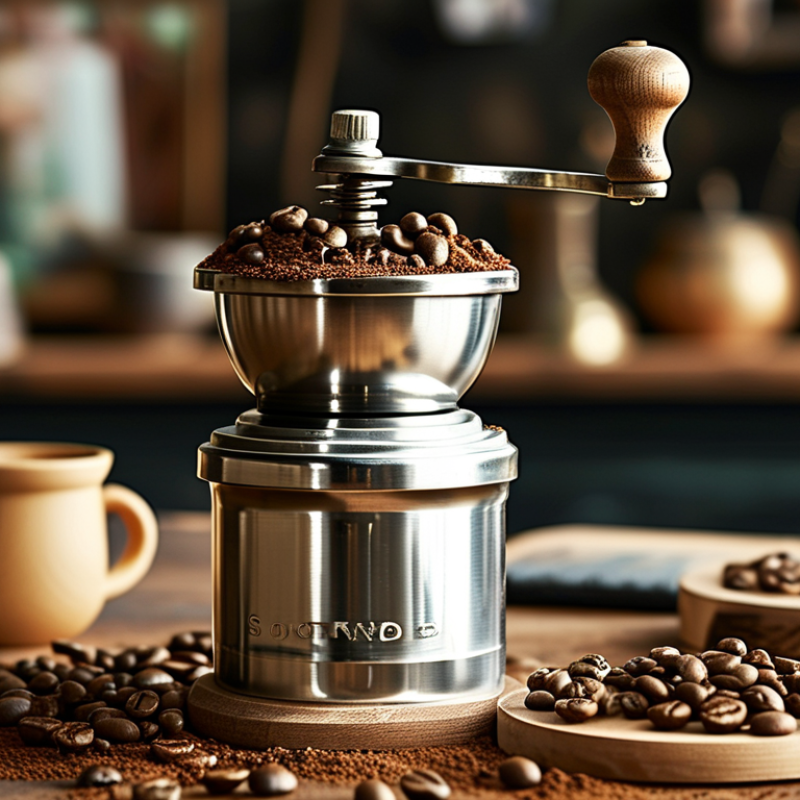
China Top 10 Stainless Steel Manual Coffee Grinder Suppliers?

Definition and Scope of Stainless Steel Manual Coffee Grinder Suppliers

Stainless steel manual coffee grinder suppliers are businesses that manufacture, assemble, or distribute hand-operated grinders with stainless steel components. These components may include the body, burr carrier, shaft, or adjustment mechanism. A steel-colored coating does not prove stainless steel construction.

Material certificates matter.

The scope includes original manufacturers, OEM factories, exporters, and specialized wholesale suppliers serving cafés, retailers, and online sellers. It excludes ordinary kitchenware traders without grinder production evidence. A credible supplier should provide burr specifications, steel grades, grind-range data, sampling procedures, and batch-level quality records.

In practical sourcing, I would also check handle stiffness and particle consistency.
Small details reveal large problems.

Market data requires careful interpretation. The International Coffee Organization reported global coffee consumption of 177.9 million 60-kilogram bags in coffee year 2022/23. This large consumption base supports continued demand for home-brewing equipment.

However, major reports often combine electric machines, capsules, and manual tools. Grand View Research’s coffee machine studies, for example, do not isolate stainless steel hand grinders consistently. Comparisons can therefore become misleading.

A supplier ranking should assess production capability, export experience, material verification, customization, and after-sales responsiveness, rather than search visibility alone. In China, factory scale may look impressive, but independent testing and repeat-order evidence remain more persuasive.
Key Criteria for Ranking China’s Top Ten Suppliers

Ranking China’s top ten stainless steel manual coffee grinder suppliers requires more than factory size. Global coffee consumption reached about 177 million 60-kilogram bags in 2022/23, according to the International Coffee Organization’s Coffee Development Report. That demand increases pressure on suppliers to deliver consistent grinding, not only attractive samples.

A practical ranking can assign 30% to grind performance, 25% to material and assembly quality, and 20% to production reliability. Testing should measure particle consistency, burr alignment, handle torque, and output after repeated use. Stainless steel claims need verification through material certificates and corrosion testing. ISO 9001 certification supports process control, but it does not prove better coffee results. Evidence matters more.

Supplier reliability deserves detailed checking. Review at least three years of export records, complaint rates, lead-time records, and replacement-part availability. UN Comtrade data can help compare China’s relevant coffee-equipment export activity, although customs categories are imperfect. They may combine different products. I would also verify factory audits, batch samples, packaging protection, and documented inspection procedures. Price should receive limited weight. A low quotation can hide unstable burr tolerances or weak after-sales support. No ranking is perfect. Rechecking suppliers after six months is sensible, especially when raw-material prices or production schedules change.

Profiles of the Top Ten Chinese Coffee Grinder Suppliers

China’s leading manual coffee grinder suppliers differ in strengths, factory scale, and quality control. A practical supplier profile should examine more than catalog photos.

One supplier may specialize in precision stainless-steel machining, using CNC processing and measured shaft alignment. Another may focus on ceramic burrs for entry-level grinders, keeping prices stable but accepting slower grinding. A third supplier often provides compact travel models with folding handles and protective cases. Small-batch manufacturers can support custom colors and packaging. Their production speed may be limited.

Mid-sized suppliers usually offer balanced capacity and flexible OEM development. They may provide sample testing, burr calibration, and assembly records. Export-oriented factories often maintain clearer inspection documents and stronger packaging procedures. This matters when grinders travel through humid ports. High-volume suppliers can deliver consistent orders, yet communication may feel less personal.

Some engineering-led suppliers invest in adjustable grind mechanisms and reduced wobble. Their prototypes may perform well, but tooling costs can be higher. Other workshops specialize in premium finishes, such as brushed steel, polished surfaces, or dark protective coatings. Appearance alone proves little. A credible profile should include material certificates, hardness checks, load testing, and a traceable defect process. Suppliers with responsive after-sales teams deserve attention, especially when replacement burrs or handles are needed. Still, factory claims require independent verification. A polished sample can hide uneven tolerances. That is where careful buyers should remain skeptical.

China Top 10 Stainless Steel Manual Coffee Grinder Suppliers

Comparison of commonly disclosed supplier capabilities based on product specialization, stainless-steel construction, customization support, export experience, and production scale.

The index is a comparative profile score from publicly observable supplier characteristics; it is not a company revenue or sales ranking. Higher values indicate broader capability coverage.

Product Quality, Customization, Pricing, and Export Capabilities

China Top 10 Stainless Steel Manual Coffee Grinder Suppliers: Product Quality, Customization, Pricing, and Export Capabilities

When comparing China’s top ten stainless steel manual coffee grinder suppliers, inspect materials before price. Food-contact stainless steel should have traceable grades and consistent surface finishing. Burr alignment matters more than polished packaging. The Specialty Coffee Association links particle consistency with better extraction control. The International Coffee Organization reported global coffee consumption near 177.9 million 60-kilogram bags in 2023/24. Demand is substantial.

Customization may include burr size, handle length, logo engraving, carton design, and grind settings. Ask for a pre-production sample. Measure grind retention and check whether the adjustment ring slips during use. A practical sourcing review often exposes weak tolerances. That is an uncomfortable detail.

Pricing should include tooling, packaging, inspection, and shipping terms. A low factory quote may become expensive after export costs. Request quotations under identical specifications, such as steel grade, burr material, unit weight, and order quantity.

Tips: Ask suppliers for material certificates, factory audit records, sample test videos, and recent export references. Confirm HS classification with a qualified customs broker. World Coffee Research emphasizes the value of controlled grinding for brewing consistency, but supplier claims still require independent testing. Compare defect rates, replacement-part support, and lead times, not only unit prices. Export experience can reduce delays, yet it does not guarantee reliable quality. Recheck every assumption.

How to Select the Right Chinese Supplier for Your Business

How to Select the Right Chinese Supplier for Your Business

Global coffee demand creates steady equipment opportunities. The International Coffee Organization reported 177.9 million 60-kilogram bags of consumption in 2023/24. For manual grinder buyers, demand alone is not enough. Supplier consistency matters more.

Start with factory evidence, not polished catalogs. Request a current business license, production photos, material certificates, and a live video inspection. For stainless steel bodies, confirm the steel grade, wall thickness, burr material, and surface treatment. Ask for tolerance records on the shaft and adjustment ring. A grinder that feels smooth today may develop wobble after repeated use. Test at least three samples from different production batches.

Quality systems deserve careful checking. The ISO Survey 2023 recorded more than 1.2 million ISO 9001 certificates worldwide, but certification does not guarantee excellent grinders. Verify the certificate through the issuing body. Request inspection plans, defect records, and corrective-action reports. Independent testing should measure grind consistency, retention, noise, and handle strength. The Specialty Coffee Association emphasizes repeatability and brewing control, which makes these tests commercially relevant. My own caution is simple: low prices often hide packaging weakness, manual assembly variation, or slow replacement support. Negotiate spare burrs, sample approval, inspection rights, and clear tolerances before payment. A supplier who refuses these details may still deliver, but the risk becomes yours.

China Top 10 Stainless Steel Manual Coffee Grinder Suppliers? - How to Select the Right Chinese Supplier for Your Business

Rank Anonymous Supplier Profile Main Manufacturing Cluster Typical Product Strength Common Product Materials Typical Burr Configuration Typical MOQ Typical OEM Lead Time Customization Capability Export & Compliance Readiness Recommended Buyer Type Preliminary Fit Score
1 Supplier Profile A Yongkang, Zhejiang Stainless steel body grinders for private-label retail 304 stainless steel housing; aluminum or stainless handle; food-contact polymer components Conical steel burrs, commonly 38–48 mm 100–300 units 30–45 days after approved sample Logo, color, packaging, handle length, grind adjustment, gift-box design Export packaging and English manuals commonly available; request food-contact and material declarations Online retailers and specialty coffee distributors 9.2/10
2 Supplier Profile B Ningbo, Zhejiang Premium-looking manual grinders with polished or brushed finishes 304 stainless steel exterior; hardened stainless steel burrs; stainless or aluminum shaft Conical steel burrs, commonly 48–51 mm 200–500 units 35–50 days after design confirmation Surface finish, laser marking, packaging inserts, carrying case, grind-setting scale Strong export-document support; verify batch traceability and inspection records Premium lifestyle and hospitality brands 9.0/10
3 Supplier Profile C Dongguan, Guangdong Precision-machined components and small-to-medium production runs 304 stainless steel body; CNC-machined aluminum parts; hardened steel burr set Conical steel burrs, commonly 38–48 mm 100–300 units 30–45 days after tooling or sample approval CNC geometry, tolerances, private labeling, custom knobs, retail packaging Suitable for export projects; require dimensional inspection and coating verification Technical brands and product-development teams 8.8/10
4 Supplier Profile D Wenzhou, Zhejiang Cost-competitive stainless steel grinders for high-volume programs 304 or 201 stainless steel exterior depending on specification; steel burrs; PP or nylon internal parts Conical steel burrs, commonly 38–48 mm 500–1,000 units 25–40 days for repeat orders Color, logo, carton artwork, basic grind adjustment, standard component changes Competitive export pricing; independently verify stainless grade and corrosion resistance Mass-market distributors and promotional programs 8.5/10
5 Supplier Profile E Yiwu, Zhejiang Small-batch private-label products and mixed-SKU sourcing 304 stainless steel contact surfaces; aluminum handle; food-grade polymer hopper or container Conical steel burrs, commonly 38–48 mm 100–200 units 30–45 days, excluding packaging development Low-volume logo printing, packaging, bundle sets, accessory selection Flexible export coordination; require pre-shipment inspection and packaging drop tests Start-ups and test-market buyers 8.4/10
6 Supplier Profile F Shenzhen, Guangdong Design-oriented grinders with upgraded user ergonomics 304 stainless steel body; anodized aluminum components; hardened steel burrs Conical steel burrs, commonly 48–51 mm 300–800 units 40–55 days for new OEM designs Handle ergonomics, magnetic containers, custom adjustment systems, packaging and manuals Strong design and engineering communication; request material and performance test reports Design-led consumer product companies 8.3/10
7 Supplier Profile G Taizhou, Zhejiang Metal forming, polishing, and standard grinder assembly 304 stainless steel shell; stainless or carbon-steel burr components; polymer base parts Conical steel burrs, commonly 38–48 mm 300–500 units 30–45 days after sample approval Brushed or mirror finish, logo marking, standard color options, carton customization Suitable for standard export orders; verify polishing consistency and burr alignment Importers seeking stable standard models 8.1/10
8 Supplier Profile H Foshan, Guangdong Kitchenware-oriented manufacturing and coordinated packaging 304 stainless steel body; aluminum or stainless handle; food-contact plastic components Conical steel burrs, commonly 38–48 mm 500–1,000 units 35–50 days for new orders Retail carton, inserts, bundled accessories, surface finish, logo placement Good packaging coordination; request food-contact documentation for all wetted or contact parts Kitchenware wholesalers and chain retailers 7.9/10
9 Supplier Profile I Jiangsu Manufacturing Belt Metal component production with emphasis on repeatability 304 stainless steel housing; hardened steel burrs; aluminum or stainless adjustment shaft Conical steel burrs, commonly 38–48 mm 500–1,000 units 35–50 days after confirmed forecast Limited structural changes, logo marking, standard finish options, export cartons Better suited to forecast-based purchasing; verify production capacity and incoming-material controls Established distributors with recurring demand 7.8/10
10 Supplier Profile J Quanzhou, Fujian Entry-level stainless steel grinders for promotional and wholesale channels 304 stainless steel exterior or mixed stainless grades by specification; steel burrs; polymer fittings Conical steel burrs, commonly 38–42 mm 500–1,500 units 25–40 days for standard models Logo, carton printing, basic color selection, standard accessory bundles Cost-focused export support; independently test material grade, burr durability, and packaging strength Promotional suppliers and value-oriented wholesalers 7.5/10

Selection note: The profiles use non-identifying supplier categories and industry-standard Chinese manufacturing ranges. Actual MOQ, pricing, lead time, material grade, certifications, and production capacity should be verified through factory audits, approved samples, third-party inspections, and written purchase specifications.

Call Now Button