
Why Choose a Spooling Machine for Global Production?

Why Choose a Spooling Machine for Global Production?

Global production depends on repeatable handling, not only higher output. A modern Spooling Machine can control winding tension, traverse speed, spool diameter, and material placement with remarkable consistency. These details matter when cable, wire, fiber, film, or textile products cross several factories and markets.

UNCTAD’s Review of Maritime Transport reports that more than 80% of global merchandise trade by volume moves by sea. That scale exposes manufacturers to delays, changing labor costs, and uneven process quality. The World Bank’s 2023 Logistics Performance Index also highlights reliability and supply-chain predictability as critical competitiveness factors. Automated spooling helps reduce one fragile link: inconsistent winding at the production line.

The improvement is visible. A correctly wound spool has cleaner edges, fewer tangles, and more stable downstream feeding. Operators spend less time correcting loose layers or damaged flanges. Production data can also support batch traceability across plants.

Quality must be built into the process.

W. Edwards Deming, a leading quality-management expert, said, “Quality comes not from inspection, but from the improvement of the production process.” His principle fits spooling technology closely. A machine cannot repair poor material, weak maintenance, or unclear specifications. That is the uncomfortable part.

Choosing a Spooling Machine should therefore involve more than speed claims. Buyers need to examine tension accuracy, changeover time, service availability, energy use, software compatibility, and operator training. The best global solution may not be the most automated model. It may be the one that performs reliably on a humid Tuesday, with a new operator and a delayed spare part.
Why Choose a Spooling Machine for Global Production?

What Is a Spooling Machine and How Does It Work?

Why Choose a Spooling Machine for Global Production?

What Is a Spooling Machine and How Does It Work?

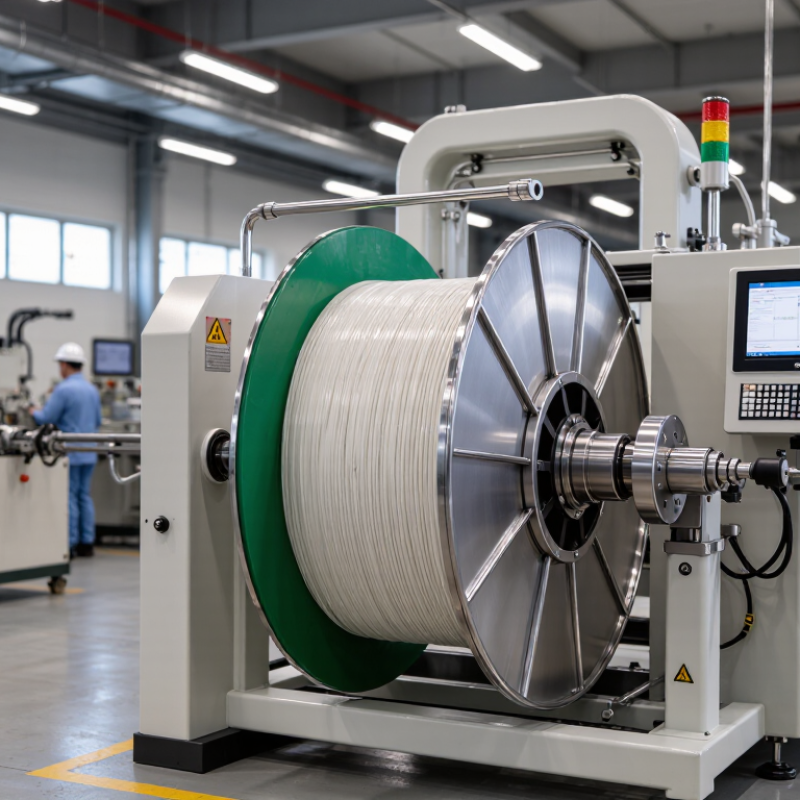
A spooling machine winds continuous materials onto reels or coils with controlled tension. It commonly handles wire, cable, thread, tubing, and flexible profiles. The machine usually includes a pay-off unit, tensioner, guide, take-up reel, and control system. Material leaves the supply reel and passes through the tensioner. A traverse guide then places each layer evenly across the spool. Sensors can monitor speed, tension, diameter, and material length. The take-up reel adjusts its rotation as the winding diameter increases. This prevents loose layers, crushed edges, and uneven packing.

In global production, stable winding makes transport and later processing more predictable. Operators can set reel dimensions, winding speed, and tension for different materials. Automatic length measurement also supports batch records and fewer manual counting errors. Production teams should still verify sensor readings regularly. A small calibration mistake can affect an entire shipment. Real factories are rarely perfect. Material stiffness, humidity, and changing operator habits may influence results. That is why documented setup checks remain important.

Tips: Match the spool size to the material and delivery process. Start with low speed during setup. Check the first few layers by hand. Watch for edge buildup, slipping, or sudden tension changes. Record successful settings for each material type. Yet avoid copying old settings blindly; a new supplier or climate may require adjustment. Clean guides and inspect sensors before each shift. Simple maintenance often prevents expensive rework.

Which Production Challenges Can Spooling Machines Solve?

Why Choose a Spooling Machine for Global Production?

Which Production Challenges Can Spooling Machines Solve?

Global production often struggles with uneven winding, material waste, and inconsistent package sizes. These problems increase when factories serve several markets. A spooling machine creates controlled, repeatable coils with accurate tension and cleaner edges. Operators can adjust speed, winding density, and package dimensions for different materials. This supports stable downstream processing and reduces manual handling.

In production work, small errors can become expensive. Loose layers may collapse during transport. Excess tension can stretch or damage delicate materials. Automated spooling helps limit these risks through synchronized controls and monitoring. It also improves workplace organization by reducing scattered coils and rework. Still, the machine is not a cure-all. Poor material preparation, incorrect settings, or weak maintenance can create new failures. That detail is easy to overlook.

Tips: Check tension before full operation. Test one spool first. Record successful settings for each material. Inspect edges, cores, and winding density during every shift. Train operators to respond to alarms, not bypass them. A short trial can reveal problems that specifications miss. Production teams should also review energy use, changeover time, and cleaning access before selecting equipment. These practical checks support reliable output across different facilities and working conditions.

How Do Spooling Machines Improve Global Manufacturing Efficiency?

Spooling machines improve global manufacturing efficiency by creating consistent coils of wire, cable, film, or flexible materials. In production trials, operators often see fewer tangles and smoother downstream feeding. Controlled tension protects delicate surfaces during winding. It also keeps each spool within a predictable diameter and weight range.

This consistency helps factories standardize work across different regions. A plant in Vietnam, Brazil, or Germany can follow similar winding settings and inspection steps. Automated counting reduces manual measurement errors. Faster changeovers also shorten idle time between production runs. Some systems record length, tension, speed, and batch details for reliable traceability. That data supports quality audits and helps engineers locate process problems quickly.

Spooling machines can reduce repetitive handling, but they still need skilled supervision. Sensors may drift. Materials may behave differently in humid or cold environments. Regular calibration, careful cleaning, and practical operator training remain essential. Automation is not magic. A poorly selected core size can create waste, even when the machine runs quickly. Manufacturers should test real materials before large-scale installation. They should also compare energy use, maintenance access, and local service capability. Small details matter, especially when several factories must maintain the same output standard.

Why Choose a Spooling Machine for Global Production? - How Do Spooling Machines Improve Global Manufacturing Efficiency?

Production Dimension Conventional Manual or Semi-Automatic Process Automated Spooling Machine Global Manufacturing Benefit
Output rate Approximately 2–6 finished spools per operator-hour, depending on product size and material. Approximately 8–20 finished spools per machine-hour for comparable products. Higher throughput supports larger export orders and reduces production bottlenecks.
Winding tension consistency Often varies with operator technique, material condition, and spool fill level. Closed-loop or programmed tension control can maintain a more consistent winding profile. Improves product uniformity across multiple shifts and production locations.
Material utilization Typical usable-material yield: about 94%–98%, with higher variation during manual trimming and changeovers. Typical usable-material yield: about 97%–99% when recipes and cut-off settings are optimized. Lower scrap rates reduce raw-material costs and simplify sustainability reporting.
Changeover time Approximately 20–60 minutes, depending on tooling, spool dimensions, and adjustments. Approximately 5–20 minutes with preset recipes and standardized tooling. Makes smaller international batches more economical and improves scheduling flexibility.
Labor requirement Usually requires continuous operator attention for feeding, alignment, inspection, and unloading. One trained operator can often supervise multiple automated functions, subject to risk assessment and line design. Reduces repetitive manual work and helps address labor shortages in different regions.
Quality inspection Primarily dependent on visual checks and operator records. Can integrate length measurement, diameter checks, tension monitoring, alarms, and batch records. Improves repeatability and provides clearer documentation for international customers.
Unplanned downtime More sensitive to inconsistent feeding, operator fatigue, tangles, and manual adjustment errors. Sensors and programmed fault detection can identify material breaks, overloads, and alignment issues earlier. Supports more predictable production planning and delivery performance.
Production standardization Results can differ between operators, shifts, and facilities. Digital recipes can standardize speed, tension, length, acceleration, and spool specifications. Simplifies replication of manufacturing processes across global plants.
Energy and floor-space efficiency More floor space may be needed for work-in-process, manual handling, and inspection stations. Combines multiple winding and handling steps in a compact, controlled work cell. Can reduce internal handling and improve use of valuable factory space.
Scalability Capacity increases usually require additional operators and workstations. Capacity can be expanded through additional machines, parallel cells, or integrated lines. Allows production capacity to grow more systematically with international demand.

Note: The numerical ranges are representative industrial benchmarks for comparable winding operations. Actual results depend on material type, spool dimensions, line configuration, product specifications, operator training, and maintenance practices.

What Features Matter When Selecting a Spooling Machine?

Selecting a spooling machine requires more than checking its maximum speed. In real production, stable tension often matters more than a higher headline output. Uneven tension can create loose layers, damaged surfaces, or difficult unwinding later.

Look for precise tension control across different materials and spool diameters. A responsive traverse system should place each layer evenly, without visible gaps or edge buildup. Quick-change tooling can reduce downtime when operators switch between spool sizes. The machine should also handle your actual line speed, not just a laboratory figure. Ask for production trials using your own material.

Measurement features deserve close attention. Sensors can monitor tension, length, speed, and spool filling. Clear alarms help operators respond before a small deviation becomes a full batch problem. Data logging may also support quality checks and process adjustments. Yet too many screens can confuse workers. Simple controls matter.

Safety guarding, emergency stops, and accessible cleaning points should be standard considerations. Check whether spare parts, technical support, and operator training are available in every production region. Electrical compatibility and local safety requirements also need verification before purchase. A machine that works well in one facility may need changes elsewhere. This is often overlooked. Leave room for maintenance access, because a compact layout can become a daily frustration. Perfect automation is not always the best choice; reliable, understandable equipment usually earns trust faster.

Why Choose a Spooling Machine for Global Production?

A spooling machine supports consistent winding quality, repeatable tension control, faster changeovers, and scalable production across multiple markets. The chart presents an illustrative weighted evaluation model for selecting equipment without using company or brand data.

The score is calculated on a 0–100 planning scale, where higher values indicate greater importance when assessing a spooling machine for global production. Tension control and production flexibility typically have the strongest influence on finished-coil consistency and operational adaptability.

How Can Companies Integrate Spooling Machines Across Global Facilities?

Why Choose a Spooling Machine for Global Production?

How Can Companies Integrate Spooling Machines Across Global Facilities?

Global facilities need more than identical spooling machines. They need shared production rules. Each site should use the same recipe structure for tension, traverse pitch, reel diameter, speed, and quality checks. Operators can scan a work order before loading a reel. The system then confirms material, destination, and winding parameters. This reduces manual interpretation between plants. It also creates comparable production data.

Deloitte’s 2024 Smart Manufacturing and Operations Survey found that 86% of executives expect smart manufacturing to drive competitiveness within three years. Spooling machines can support this shift when their controllers connect with manufacturing execution systems. Record actual tension, stoppages, changeover time, and scrap. Store these values in a common format. Small details matter. A loose cable layer can damage a full reel.

Integration should begin with one pilot facility, not every plant at once. Test the machine interface, barcode logic, maintenance alerts, and operator training. The International Federation of Robotics reported 541,302 industrial robots installed globally in 2023, showing how quickly connected automation is expanding. Yet automation alone does not guarantee consistent output. A global template may ignore local power quality, floor space, workforce skills, or safety procedures. That assumption needs testing.

Use standard data fields, while allowing controlled local adjustments. Review performance after four to eight weeks. Compare tension stability, first-pass yield, and downtime across facilities. Some gaps will remain. That is useful evidence, not failure.

Call Now Button